EN

What Questions Come Up Before Sealing a Three-Leg Body?
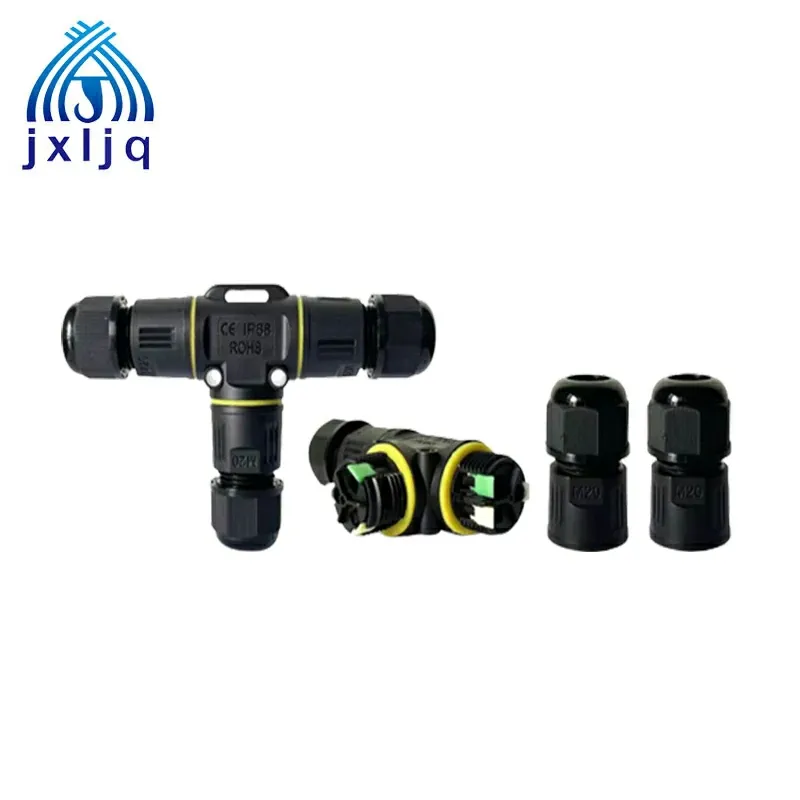
A Waterproof Connector with a T-shaped body has three cable entries where a straight connector has two, and every entry is a path for water to reach the conductors. You'll see why each leg needs its own seal, how the JIXIANG T-type body holds those three seals, and where the M20 and M25 series sit in the current and pin-count envelope.
What Questions Come Up Before Sealing a Three-Leg Body?
Why doesn't one seal cover the whole connector?
A T-type body has three separate cable entries: one incoming and two outgoing. Each entry has its own gland, its own seal, and its own retaining ring. A single seal around the body would protect the joint but not the point where each cable jacket enters the housing—and that entry point is where water reaches the conductors if the gland isn't compressed onto the jacket. The page lists IP68 for the T-type series, with the connector described as able to work underwater for a long time. That rating is per entry, not per body.
Does each leg need a different seal size?
Yes, if the cables are different diameters. The page lists cable OD ranges in steps: 5–8mm and 9–12mm on the M20, and 5–8mm, 9–12mm, and 10–14mm on the M25. A branch where the incoming cable is 10mm and the outgoing cables are 7mm needs a 9–12mm gland on the incoming leg and 5–8mm glands on the outgoing legs. Matching each gland to its cable is what makes the three seals work as a set.
The Three Sealing Paths and the Gland Stack
Each leg of the T-body has the same sealing stack: gland body, seal, retaining ring, and cable jacket. The page describes the threaded gland body as guaranteeing the safety of the connection while keeping the screw simple to tighten, and the seal as having a smooth surface without burr.
The retaining ring is the component that assembles the seal and clamp into one unit. When the gland is tightened, the seal compresses against the cable jacket and the retaining ring holds it in position. On a three-leg body, that sequence runs three times—once per cable—and the IP68 rating only holds if all three glands are tightened to the correct compression.
The housing material is PA66, listed as flame retardant, with the contact components made from copper alloy. PA66 holds the three threaded entries in a fixed geometry while resisting the environment the connector is rated for—so the three glands stay aligned with the internal terminals as the body expands and contracts.
| Parameter | JX-M20 series | JX-M25 series |
|---|---|---|
| Thread size | M20×1.5 | M25×1.5 |
| Voltage rating | 380V | 380V |
| Current rating | 16A | 25A |
| Cable OD | 5–8 / 9–12mm | 5–8 / 9–12 / 10–14mm |
| Pin version | 2, 3 pin | 2, 3, 4, 5 pin |
| Wire size | 0.2–2.5mm² | 0.2–2.5mm² |
| Stripped length | 14mm | 11mm |
| Termination | Clip | Screw |
| Overall length | 110×71mm | 91.5×96.5mm |
Why the retaining ring is the seal's anchor
The page lists a four-step sequence: insert the cable, connect the terminals, press the retaining ring, and tighten both ends. The retaining ring comes before the final tighten because it positions the seal around the cable jacket while the gland is still loose. If the gland were tightened first, the seal would be pushed into position by the tightening action rather than seated evenly—and an unevenly seated seal is where a leak starts.
Strain Relief and the Pull Directions
The page lists strong tensile resistance as a feature of the housing design. On a T-type connector, strain relief matters more than on a straight connector because the branch legs can be pulled in different directions—a tug on one branch leg loads the T-body at an angle rather than along a single axis.
Each gland's clamp handles the pull on its own cable. The T-body transmits the combined load to the housing, and the PA66 material holds the three entries in alignment. If one leg's gland is under-tightened, the pull on that cable transfers to the terminal inside the body rather than to the gland—which is why the three seals have to be tightened as a set, not just the one that's easiest to reach.
-
M20 cable OD: 5–8mm or 9–12mm
-
M25 cable OD: 5–8mm, 9–12mm, or 10–14mm
-
Wire size: 0.2–2.5mm² across both series
-
Stripped length: 14mm on M20, 11mm on M25
-
Housing: PA66, flame retardant
-
Contacts: copper alloy
What the current rating means for a three-leg branch
The M20 is rated 16A and the M25 is rated 25A, both at 380V. In a T-branch, the current from the incoming leg splits between the two outgoing legs. The connector's rating applies to the current through each conductor path, so the branch legs can each carry up to the rated current as long as the incoming supply and the conductor size support it. The 0.2–2.5mm² wire range is the conductor gauge that matches those current ratings.
Installation Sequence and the Three Seals
The page lists a four-step connection sequence: insert one end of the cable, connect the terminals at both ends, press the retaining ring, and tighten both ends.
That order matters for all three seals. The cable is inserted first, then the conductors are terminated, then the retaining ring is pressed to assemble the seal and clamp, and finally the gland is tightened. If the gland were tightened before the conductors were terminated, the cable would be locked in place before the electrical connection was made—and the installer would have to loosen the gland to reach the terminals, which risks disturbing the seal on that leg.
Why the seals should be checked after the first temperature cycle
A gland that's tightened to the correct compression at room temperature can loosen slightly after the connector goes through its first heating and cooling cycle, because the cable jacket and the seal material expand and contract at different rates. Re-checking the gland tightness after the first cycle confirms that all three seals are still compressed against their jackets—not just the one that was tightened last.
Where the T-Type Connector Fits a Wiring Layout
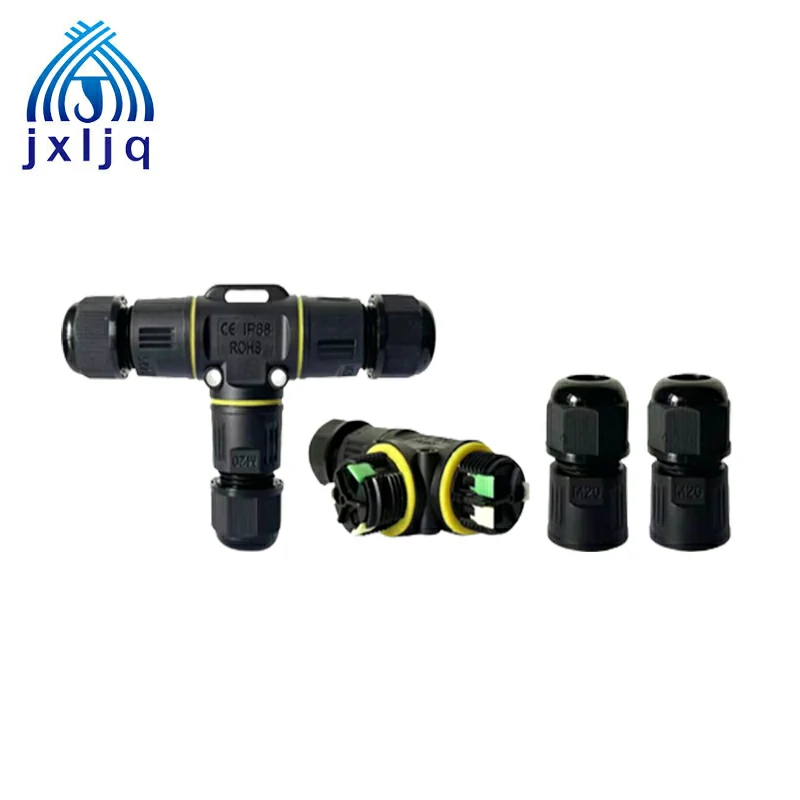
The Waterproof Connector T-type series from JIXIANG CONNECTOR is built around the three-seal requirement the page describes: a three-leg body with IP68 sealing at each entry, PA66 flame-retardant housing, copper alloy contacts, and a current rating of 16A on the M20 and 25A on the M25. The pin counts run from 2 to 5, the cable OD ranges cover 5–14mm, and the termination is clip-type on the M20 and screw-type on the M25. For an outdoor lighting run, a sensor branch, or a power distribution line that needs a sealed three-way split, the value sits in the per-leg seal—each cable is gripped and sealed independently, so one cable's pull doesn't disturb another cable's seal.
What to confirm before specifying a T-type branch
Confirm the cable OD against the gland range (5–8, 9–12, or 10–14mm), the conductor gauge against the 0.2–2.5mm² wire size, and the current against the 16A or 25A rating. Check the pin count against the number of conductors in the branch, and the termination type against the serviceability the installation requires. The page's series data gives the starting point; the actual cable and routing determine which gland size and pin version fit.
Let's Match a T-Branch to Your Cable Run
Send over your cable OD, conductor count, current load, and routing layout—we'll help you check them against the M20 and M25 T-type bodies, the 2–5 pin configurations, and the IP68 sealing envelope. Talk to JIXIANG CONNECTOR about your Waterproof Connector requirements and get a configuration-level answer before you commit to the wiring.