EN
EN
Marine Cable Glands for Ships & Offshore Platforms
Three months into a North Sea patrol, a cargo vessel's fire detection system began sending intermittent false alarms. The crew traced the issue to the engine room, but the sensors checked out. The control panel was dry. The fault, eventually discovered during a port inspection, was water tracking along the inner threads of a seemingly tight cable entry point. The fitting looked fine from the outside. Inside, chloride crystals had formed a conductive bridge across the termination block.
Stories like this are common in marine engineering circles. The offshore environment is uniquely punishing. Equipment faces not just water, but salt-laden spray, constant vibration from propulsion systems, and the occasional direct hit from deck washdown hoses. According to corrosion engineering data, the average annual cost of corrosion control for a merchant vessel can run into millions of dollars, with electrical system degradation representing a significant portion of that figure .
So, how do you ensure that a simple wiring pass-through doesn't become your vessel's weakest link? The answer lies in understanding three critical stress points: material metallurgy, seal resilience, and certification validity.
Step 1: Prioritize Metallurgy for Chloride-Rich Environments
Standard brass fittings, even with nickel plating, will eventually succumb to a phenomenon called "dezincification" in seawater exposure. Zinc leaches out of the brass alloy, leaving behind a porous, weak copper structure that crumbles under vibration. This is not a matter of "if" but "when."
For any location exposed to salt spray, direct seawater splash, or high-humidity bilge areas, 316 stainless steel is the industry baseline. Unlike 304 stainless (sometimes called "food grade"), 316 contains molybdenum, which provides specific resistance to chloride-induced pitting. A vessel operating in tropical waters or the Persian Gulf faces even higher salinity and temperature, accelerating corrosion rates significantly.
When evaluating a component, check the material certificate if available. For bronze or nickel-aluminum bronze, sometimes used in underwater applications, ensure the alloy specifically references marine service (e.g., AB2 grade). If a supplier cannot specify the exact material standard, that is a red flag.
Step 2: Demand Double-Sealing and Vibration Locking
A standard IP66 fitting uses a single rubber grommet. It compresses around the cable when you tighten the nut. But on a vessel, nothing stays still. Engine vibration, hull flexing, and even wave impact create cyclical movement. Over weeks, a standard grommet can "cold flow," gradually relaxing its grip.
Marine-specific designs incorporate either a double-compression mechanism (two independent sealing points) or a conical claw that bites axially into the cable jacket. The latter is particularly effective for unarmored cables, which are common for lighting and general power circuits.
Equally important is vibration locking on the enclosure entry. A simple flat washer is not enough. Look for a fitting that includes a serrated locknut or a separate anti-vibration washer that digs into the enclosure surface. This prevents the entire assembly from rotating loose when the main engine is running at cruise RPM. According to IEC 60079-0 (the base standard for hazardous area equipment which shares many mechanical test requirements with marine standards), cable entries must withstand pull-out torque and vibration tests without loosening or losing seal integrity .
Step 3: Match Ingress Protection to Actual Deck Location
Here is a common mistake: specifying IP66 for every location because it sounds sufficient. In reality, different zones of a vessel have different requirements.
-
Accommodation and bridge: IP44 or IP54 typically sufficient (protection against splashing from any direction).
-
Engine room, pump rooms, and weather decks: IP66 minimum (protection against powerful water jets or heavy seas).
-
Bow thruster compartments, underwater sonar rooms, or bilge areas: IP68 required (protection against continuous immersion).
However, be aware that an IP68 rating is not universal. The manufacturer must specify the depth and duration of immersion (e.g., "IP68 up to 3 meters for 7 days"). For vessels that undergo regular dry-dock cleaning with high-pressure washers (often exceeding 100 bar), an IP69K rating—which tests against high-temperature, high-pressure steam cleaning—is the gold standard for exposed deck fittings.
An OSV operator once reported that after switching to IP69K-rated entries on their main deck lighting circuits, unplanned downtime for electrical faults dropped by nearly 70% over two dry-dock cycles. While this is an anecdotal figure, the underlying principle is sound: over-specifying protection for wet areas pays for itself in avoided maintenance.
Step 4: Check Third-Party Certifications (Not Just "Marine Grade")
The phrase "marine grade" is unregulated. Any manufacturer can stamp it on a box. What matters is independent verification. Look specifically for:
-
IEC 60529: The international standard for ingress protection. The certificate should list the exact IP code achieved after testing.
-
Lloyd's Register (LR), DNV, or ABS Type Approval: These classification societies certify components for use on vessels that fly their flags. DNV, for example, has specific testing regimes for vibration and thermal cycling for cable entries used in engine-room areas .
-
IEC 60079-0 / ATEX (optional but valuable): Even if you are not in a flammable gas environment (Zone 1/2), the ATEX/IECEx certification process requires extreme mechanical and thermal tests that exceed general industrial requirements. A fitting with an Ex e (increased safety) or Ex db (flameproof) certification has proven its robustness under conditions that mimic vessel service.
If a supplier cannot produce a DNV or ABS certificate for the specific model you are considering, assume it has not been tested for shipboard vibration and thermal shock.
For a list of certified models with available DNV and ABS documentation, explore the certified vessel fittings here .
Step 5: Plan for Cable Armor Termination
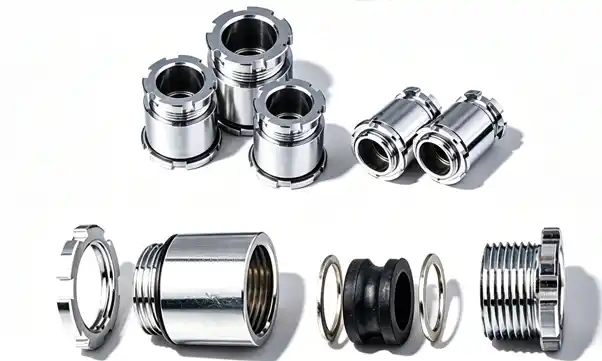
Many vessel power circuits use steel wire armored (SWA) cable, particularly for runs between switchboards and heavy motor starters. The armor provides mechanical protection and serves as a grounding path. However, terminating SWA cable requires a specific gland design that includes:
-
A conical armor cone that sits between the wire layers.
-
A clamping ring that compresses the cone, trapping the armor wires.
-
A grounding washer or tag that provides a low-resistance path to the enclosure earth.
Using a standard unarmored gland on SWA cable leaves the armor wires uncut or unclamped, which is both dangerous (sharp wires can pierce other conductors) and non-compliant with marine electrical regulations (typically IACS rules or local flag state requirements).
The correct installation sequence is critical: strip the outer sheath, fold back the armor wires over the cone, then tighten the clamping ring before the main seal is compressed. Many electricians new to marine work skip the armor cone step, assuming the cable tie will hold everything. It will not.

Common Maintenance Mistakes Offshore
Even a perfect installation can fail if maintenance crews make these errors:
-
Over-greasing threads: Some believe packing the threads with anti-seize compound improves sealing. In fact, excess grease can hydraulically lock the threads, preventing proper torque application and causing the fitting to crack later.
-
Mixing brass and stainless: Threading a brass fitting into a stainless steel enclosure (or vice versa) creates galvanic corrosion. The less noble metal (brass) will corrode rapidly. Use an isolation washer or keep materials consistent.
-
Reusing O-rings: The internal O-ring that seals between the gland body and the enclosure face is a single-use component in high-vibration environments. Once compressed, it takes a permanent set. Replace it during any re-entry.
The Cost of Getting It Wrong
Consider a real-world example from a tugboat operator in Singapore (name withheld for confidentiality). They experienced repeated failures of navigation light circuits on the mast. Each failure required a crane rental and a day in port. Total cost per incident: approximately $8,000 in lost revenue plus parts. The root cause was eventually traced to nickel-plated brass fittings that had dezincified after only 14 months. Replacing all mast fittings with 316 stainless steel, double-sealed units solved the problem permanently. The payback period was less than two breakdown cycles.
Final Recommendations for Procurement
When building your procurement list for a new build or refit, prioritize these three non-negotiable features:
-
Material traceability to 316 stainless or better.
-
A dual-seal or conical claw design with published IP66/IP68 test data.
-
Third-party type approval from a recognized classification society (DNV, LR, ABS, or BV).
If you are managing multiple vessels or a single offshore platform, standardizing on a single reliable brand simplifies spare parts inventory and training. Crews learn one torque value, one assembly sequence, and one set of spare O-rings.
If you are currently reviewing suppliers for your next marine electrical package, you can request the technical datasheet and certificate package here . The right fittings do not just complete a circuit—they protect your operations against salt, spray, and the relentless motion of the sea.
Disclaimer: This information is compiled from industry technical resources and corrosion engineering data for general guidance. Always verify specific vessel classification requirements and material compatibility with a qualified marine electrical engineer before procurement.