EN
EN
Does a 90‑degree brass elbow for a waterproof cable gland maintain a perfect seal through a 60°C temperature swing on a ship's deck?
A port engineer in Singapore once traced a recurring short circuit in a deck lighting system to a standard straight waterproof cable gland. The cable had been bent sharply to fit into the junction box, creating a small gap between the seal and the jacket. Salt spray crept in over months, and the lights failed during a monsoon. The replacement was a 90‑degree brass cable gland . The cable entered straight, turned neatly, and the rubber seal maintained full contact. The lights stayed on.
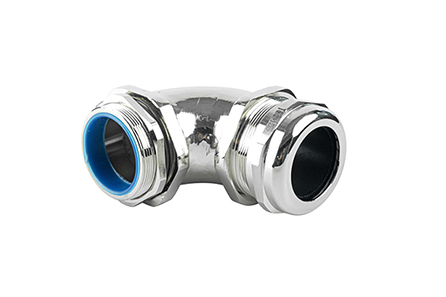
A 90‑degree elbow gland does more than just change direction. The brass body houses a seal and clamp system that tightens the sealing ring in a circular sequence without twisting the cable. The internal structure keeps the cable centred while the gland is tightened, eliminating the strain‑relief failures that cause intermittent short circuits on moving equipment. This guide walks through why the nickel‑plated brass body outlasts plain brass in marine environments, how the nitrile rubber (NBR) O‑ring behaves across the -40°C to +100°C range, what the IP68 rating actually means when the gland is mounted on a vibrating junction box, and how the JIXIANG product matrix – from M12 threads for 3mm instrumentation cables up to M48 for 32mm power feeds – covers a ship, a charging station, or a tunnel lighting system.
Nickel‑plated brass: why the dull yellow alloy survives where bright brass turns to green
A basic brass waterproof cable gland is made from standard copper‑zinc alloy. In a marine environment or a chemical plant, the zinc leaches out over time – a process called dezincification. The surface becomes porous and turns a telltale pinkish green. The gland loses mechanical strength, and the threads seize.
The JIXIANG 90‑degree elbow gland uses nickel‑plated brass. The nickel layer acts as a barrier against chloride ions, preventing dezincification. The gland body maintains its threading integrity and seal compression even after years of exposure on a supply ship‘s fire‑fighting pipeline. For outdoor lighting applications, the nickel‑plated finish resists the UV‑accelerated tarnishing that makes plain brass look like a corroded museum piece within two years.
| Material Parameter | JIXIANG 90° Brass Gland |
|---|---|
| Body material | Nickel‑plated brass |
| Clamping parts | Polyamide (PA) |
| Seal / O‑ring | Nitrile rubber (NBR) |
| Thread size range | M12 to M48 |
| Cable range (mm) | 3‑6.5 up to 22‑32 |
| Protection rating | IP68 |
The nitrile rubber O‑ring: what happens when the junction box sits in direct sunlight
Nitrile rubber (NBR) is specified for cable glands because it has a wide useful temperature range: -40°C to +100°C, with short‑term peaks up to 120°C. In a tunnel lighting application, the gland may see 40°C ambient plus heat from the luminaire. On a ship’s deck, the same waterproof cable gland must seal at 0°C in a winter storm and remain flexible enough to absorb vibration without cracking.
The JIXIANG 90‑degree gland uses a ratchet self‑locking feature. The mechanism creates an internal friction lock that resists loosening from vibration – the kind that shakes a connector on an offshore drilling platform or a portable generator mounted on a truck.
IP68: what a constant 1‑meter water column means when the cable gland is upside down
The industry standard for waterproof cable gland is IP68: dust‑tight and protected against continuous immersion in water to a depth specified by the manufacturer. For the JIXIANG 90‑degree series, the rating is tested at 1 atmosphere of pressure for 8 hours – equivalent to approximately 10 metres of water column. That covers submersion in a flooded cable trench, a deck hose‑down, or a monsoon downpour on an outdoor lighting pole.
Straight glands maintain their IP rating when the cable enters from a horizontal direction. A 90‑degree elbow gland reverses the geometry: the cable enters straight, but the gland is often mounted with the elbow pointing up, down, or sideways. The sealing system must work regardless of orientation. The JIXIANG design uses an internal clamp that tightens the sealing ring in a circular sequence without twisting the cable. The compression is uniform around the entire circumference – whether the gland is upright or inverted.
Why a nylon part holds the cable while brass keeps the seal
The gland‘s clamping parts are made of polyamide (PA), not brass. Polyamide is tough, lightweight, and does not gall against the brass thread. It also provides electrical insulation between the cable braid and the metal gland body, which is required in petrochemical installations where stray currents could create a spark hazard.
From M12 to M48: which thread fits your cable and your junction box
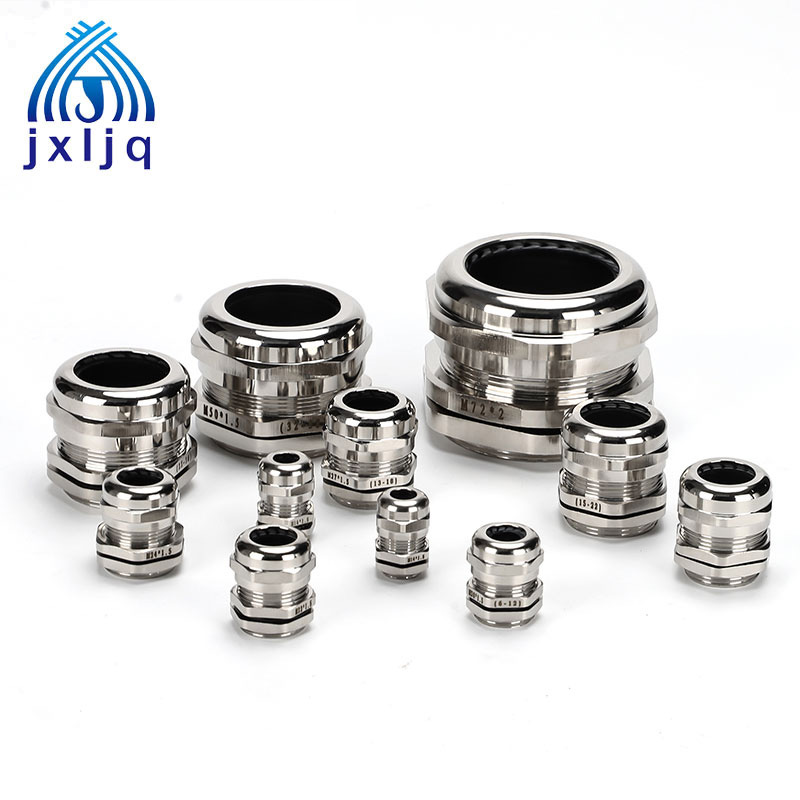
The JIXIANG 90‑degree elbow gland is offered in metric thread sizes from M12 to M48. The table below shows the thread diameter and the corresponding cable range for common sizes.
| Thread Size | Cable Diameter Range (mm) | Typical Application |
|---|---|---|
| M12 | 3‑6.5 | Instrumentation, sensors, small junction boxes |
| M16 | 4‑8 / 5‑10 | LED luminaires, outdoor lighting fixtures |
| M20 | 6‑12 / 8‑14 | Charging stations, industrial control panels |
| M25 | 10‑16 / 13‑18 | Shipboard lighting, tunnel lighting systems |
| M32 | 13‑18 / 15‑22 / 18‑25 | Petrochemical conduit entry, power feeders |
| M40 | 18‑25 / 22‑30 / 22‑32 | Main power for supply ships, offshore platforms |
| M48 | 22‑32 | Heavy‑duty industrial cable entry |
The thread length also varies by size: smaller M12‑M18 glands have a thread length of 9‑10mm, while M20 and above have 15mm to pass through thicker junction box walls.
Where the 90‑degree elbow solves a problem that straight glands cannot
A straight waterproof cable gland is simple. The cable enters in a straight line, the seal compresses, and the nut tightens. When the junction box is mounted on a wall and the cable comes from the floor, a straight waterproof cable gland works. When the cable comes from a conduit at a right angle, the installer solves the problem by bending the cable – which creates the gap that let moisture into the Singapore deck lighting.
The 90‑degree elbow gland routes the cable into the box without bending the cable itself. The cable enters the gland straight, turns 90° inside the brass housing, and exits into the box in the desired direction. The external bend is eliminated, and the internal seal remains under even compression.
The internal mechanism includes a seal and clamp system that tightens in sequence, preventing the cable from twisting during installation. The internal ratchet with self‑locking protects the connection from vibration. And because the system requires no disassembly, the installer cannot lose parts – a common source of field failures on multi‑component glands.
Three installation errors that ruin an IP68 brass cable gland – and how to avoid them
Error one: Overtightening the gland nut
The most common field mistake is tightening the gland nut until it stops. The seal compresses, the internal clamp crushes the cable jacket, and the insulation is damaged. Over weeks of thermal cycling, the crushed area cracks, moisture enters, and the IP68 rating is lost. The correct torque is hand‑tight plus one‑quarter turn. The seal is fully compressed before the nut bottoms out; the last part of the turn only stresses the threads.
Error two: Using a cable that is undersized for the gland
A M20 gland rated for 6‑12mm cable will not seal a 5‑mm cable. The rubber sealing ring is designed to compress within a specific range. Below the minimum, the seal does not contact the jacket, and moisture bypasses it. Above the maximum, the seal cannot expand enough to fit, or the cable cannot enter at all. The cable diameter range is printed on the product label – match it to the cable‘s outer jacket, not its conductor size.
Error three: Forgetting the locknut on the inside of the junction box
The 90‑degree elbow gland has a locknut that secures it to the box‘s wall. The installer tightens the gland from the outside, the locknut from the inside. If the locknut is omitted, the gland can rotate when the cable is pulled, breaking the seal. The locknut also provides strain relief by preventing the gland from pulling through the hole.
Five industries that specify 90‑degree brass cable glands
The JIXIANG 90‑degree brass waterproof cable gland (主词加粗第3次) is used in applications where reliability, corrosion resistance, and space‑saving geometry are requirements.
-
Lighting systems (indoor and outdoor) – LED streetlights, tunnel lighting, stadium floodlights. The 90‑degree elbow routes the cable into the fixture housing without a tight bend that would stress the internal terminals. The nickel‑plated brass resists road spray in tunnel applications.
-
EV charging stations – A charging station‘s internal wiring must withstand repeated thermal cycling as the charger runs for hours, then cools. The IP68 rating means the gland continues to seal after the station is pressure‑washed. The brass body provides the mechanical strength to support heavy cables without pulling out of the enclosure.
-
Petrochemical plants – Offshore drilling platforms and refineries require cable entries that seal against salt spray and hydrocarbon vapours. The JIXIANG gland is constructed with materials that resist chemical attacks. The polyamide clamp provides electrical isolation in potentially explosive atmospheres.
-
Marine and shipbuilding – On a supply ship, a waterproof cable gland seals fire‑fighting pipeline wiring and liquid pipeline monitoring systems. The nickel‑plated brass survives the saltwater environment where untreated brass would corrode within months. The ratchet locking system stays tight under the constant vibration of a running vessel.
-
Power substations – Outdoor control cabinets house sensitive protection relays. The IP68 gland prevents moisture ingress during heavy rain or flooded cable trenches. The M32‑M48 sizes handle the large‑gauge control cables used in grid infrastructure.
[Image: JIXIANG 90‑degree elbow brass cable gland installed on a stainless steel junction box, showing the locknut inside the box and the cable entering without sharp bending]
How the JIXIANG 90‑degree elbow gland fits into a corrosion‑resistant connector strategy
JIXIANG Connector (Wenzhou Jixiang Connector Manufacturing Co., Ltd.) has been producing waterproof cable gland (主词加粗第4次) and connectors for over twelve years. The company‘s products are used in lighting, marine, industrial control, and EV infrastructure applications. The manufacturing process includes nickel‑plating on brass, injection moulding of polyamide parts, and assembly of multiple seal sizes to match specific cable diameters.
The 90‑degree brass elbow gland is part of a broader line that includes straight brass glands, plastic cable glands, stainless steel glands, and multi‑hole glands for several small cables entering one enclosure. The M12‑M48 thread range covers most standard junction box entries used in European and Asian markets. The IP68 rating is verified by third‑party testing at 1 atm for 8 hours.
For a waterproof cable gland that survives thermal cycling on a supply ship‘s deck, routes cables into tight lighting fixtures without bending stress, and seals against IP68 immersion, the JIXIANG 90‑degree nickel‑plated brass elbow provides the internal clamp system, ratchet lock, and wide cable range that field engineers trust.
【Request a quote from JIXIANG Connector】
Contact JIXIANG with your thread size (M12‑M48) and cable outer diameter range to receive a 90‑degree brass elbow gland quotation.